There are musicians you listen to, and then there are musicians who become part of the soundtrack of your life.
For anyone who grew up around the Gulf Coast, Florida, or especially the Florida Keys, Jimmy Buffett was the latter.
His music was everywhere. It was playing on boats, in bars, at backyard parties, on radios during long drives and from somebody’s battered speakers while they were attempting to convince everyone that they absolutely knew how to operate a boat. Jimmy Buffett didn’t simply write songs about escaping to paradise. He helped define what paradise sounded like.
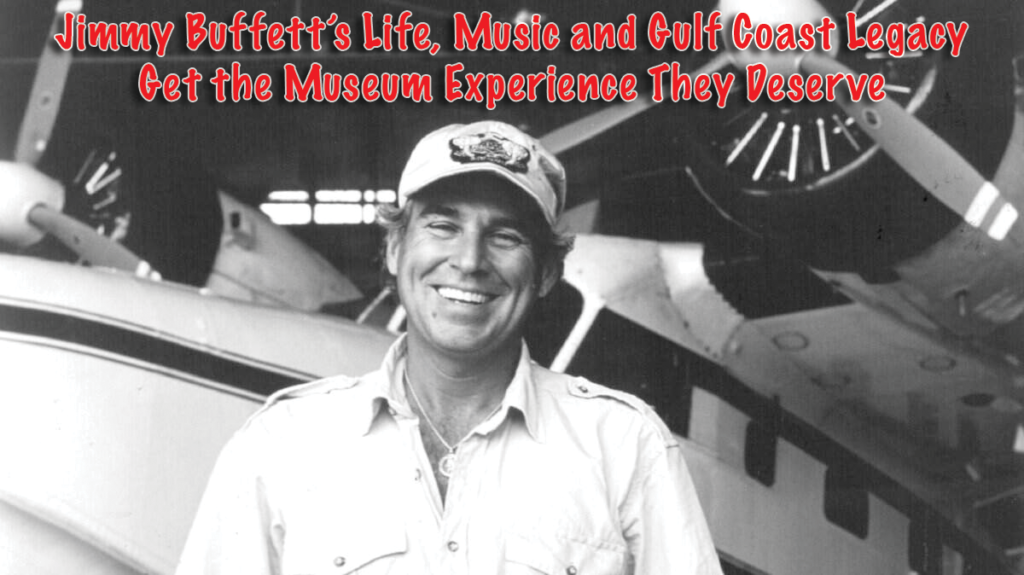
That is why the announcement of a permanent Jimmy Buffett: Son of a Son of a Sailor Experience at the National Maritime Museum of the Gulf in Mobile, Alabama, hits a little differently.
The 6,000-square-foot experience opens to the public September 12, 2026, and promises something considerably more interesting than a room full of framed album covers. The museum has assembled more than 130 artifacts from Buffett’s life, including handwritten lyrics, personal photographs, never-before-released concert and recording footage, his 12-string Martin guitar, and even Buffett’s Rock & Roll Hall of Fame statue.
And yes, they are recreating Shrimp Boat Sound, Buffett’s legendary recording studio in Key West.
Now we’re talking.
Jimmy Buffett Was More Than Margaritaville
It is easy to reduce Jimmy Buffett to Margaritaville, cheeseburgers, flip-flops and frozen drinks. The man certainly didn’t discourage that image. He built an enormous business empire around it, because apparently writing songs about wasting away in paradise wasn’t enough. The guy decided he might as well build paradise into a corporation.
But the music was always bigger than the brand.
Buffett released more than 30 albums during his career, developed a distinctive blend of country, folk, rock, Gulf Coast sounds and Caribbean influences, and built a following that turned the word Parrothead into an actual cultural identity.
And while critics occasionally treated him like the musical equivalent of a beach chair, the numbers tell a very different story.
“Margaritaville” peaked at No. 8 on the Billboard Hot 100 and reached No. 1 on the Adult Contemporary/Easy Listening chart. It eventually became one of the most culturally significant recordings in American popular music, earning induction into the Grammy Hall of Fame and later being selected for preservation in the National Recording Registry.
Then came “It’s Five O’Clock Somewhere” with Alan Jackson. The song spent eight weeks at No. 1 on Billboard’s Hot Country Songs chart, won the CMA Award for Vocal Event of the Year and picked up two Academy of Country Music Awards. It was also Buffett’s first major industry award after roughly three decades in the business.
And yes, Buffett eventually had a No. 1 album on the Billboard 200. License to Chill reached the top in 2004, followed years later by Take the Weather With You.
Buffett also received two Grammy nominations and, in 2024, was posthumously inducted into the Rock & Roll Hall of Fame with the Musical Excellence Award.
So, no, Jimmy Buffett wasn’t merely the guy who wrote the song people sang after their third margarita.
He was a remarkably successful songwriter, performer, author, businessman, sailor, pilot and storyteller who managed to turn a particular vision of coastal life into an entire cultural universe.
The Hidden Studio That Helped Create the Sound
One of the most fascinating pieces of the new exhibit is the recreation of Shrimp Boat Sound, Buffett’s Key West recording studio.
And if you’ve ever walked around the Key West waterfront, you may have walked right past it without realizing what was hiding inside.
Buffett leased an old ice house near the shrimp docks in 1986 and transformed the building into a working recording studio. The unassuming structure near the Historic Seaport became a creative home for Buffett and the musicians around him.
That’s one of the things I love about Key West.
The place has always had a habit of hiding extraordinary stories behind completely ordinary doors.
You could be walking down the waterfront thinking you’re looking for a cold beer and a place to watch the sunset, while 20 feet away some of the music that would eventually define an entire generation was being created.
The new Mobile exhibit will recreate that studio environment using personal items from the original space.
For someone who grew up in the Florida Keys, that’s not just a cool museum display. That’s a piece of home.
A1A Is Now Jimmy Buffett Territory
And Florida has already made one pretty significant statement about Buffett’s place in the state’s cultural history.
In 2024, Florida officially designated State Road A1A as the Jimmy Buffett Memorial Highway, honoring the coastal road that runs through so many of the communities and landscapes that helped shape his music.
Buffett even named his 1974 album A1A after the legendary Florida highway.
The official dedication took place in Key West, where signs were unveiled along the route. The designation stretches across A1A’s Florida corridor, connecting the Atlantic coastline from the Keys through much of Florida’s eastern shore.
For those of us who have spent time driving Florida’s coast, there is something almost perfect about that.
A highway built for people going somewhere slowly now carries the name of a guy who spent his career convincing us that maybe we shouldn’t be in such a damn hurry in the first place.
From Mobile to Key West and Everywhere in Between
The new museum experience also brings Buffett’s Gulf Coast roots into focus.
Buffett was born in Pascagoula, Mississippi, and raised in Mobile, Alabama. His family had deep connections to the maritime industry, and the new museum sits on Mobile’s waterfront near the area where his parents worked at Alabama Dry Dock and Shipbuilding. The exhibition also incorporates artifacts connected to his grandfather’s maritime history.
That makes the location particularly appropriate.
Buffett’s story didn’t begin in Margaritaville.
It began around the water.
The boats, docks, fishermen, sailors, musicians, bars, beaches and characters he encountered throughout his life eventually found their way into his songwriting. By the time he became synonymous with tropical escapism, he had already spent decades absorbing the places and people that made his music feel authentic.
That’s probably why the songs worked.
They weren’t manufactured in a boardroom by somebody who had recently discovered that Americans enjoy beaches.
Jimmy actually lived the life.
A Living Tribute, Not a Mausoleum
The museum is calling the installation a living experience, and that’s an important distinction.
The exhibit is designed to evolve as additional stories, artifacts and memories emerge. It includes interviews with family members, bandmates, crew members, friends, fishing buddies, boat builders, producers, musicians and others who were part of Buffett’s world.
The opening weekend begins September 11 with “Margaritas and Memories,” featuring Mac McAnally and Scotty Emerick at Mobile’s historic Saenger Theater.
The following day brings the official opening of the exhibit along with the unveiling of a larger-than-life bronze sculpture of Buffett. Additional live music and a nautical-themed mural festival are also planned around Cooper Riverside Park.
That sounds much more like Jimmy’s kind of museum opening.
Nobody needs a solemn room where everyone whispers while staring at a pair of old sunglasses.
Turn on the music.
Tell some stories.
Put a boat somewhere nearby.
And for God’s sake, somebody find the margarita machine.
The Music Doesn’t Need a Museum to Stay Alive
The strange thing about Jimmy Buffett’s legacy is that his music doesn’t really feel historical.
Play “Come Monday.”
Play “Son of a Son of a Sailor.”
Play “A Pirate Looks at Forty.”
Play “Fins.”
Play “Cheeseburger in Paradise.”
Then throw on “Margaritaville.”
You don’t suddenly feel like you’re listening to some forgotten artist from another era. You feel like you’re sitting somewhere near the water, probably with a drink in your hand, wondering why you have responsibilities tomorrow.
That’s the trick Buffett pulled off.
He didn’t just write songs people remembered.
He created places people could mentally return to.
For me, growing up in the Florida Keys, that matters. Jimmy’s music wasn’t something I discovered later in life. It was part of the environment. It was woven into the Florida experience long before I ever understood how unusual that was.
And maybe that’s why the new Son of a Son of a Sailor Experience feels so meaningful.
Jimmy Buffett spent his career reminding people that life was supposed to be lived.
Not perfectly.
Not efficiently.
Not according to some five-year plan written by a guy named Brad in a corporate office.
Just lived.
Preferably near the water.
With good music playing.
And maybe a cold drink within reach.
That’s a pretty damn good legacy.
Static Live Music App
If you’re looking for the next concert, festival or live music event happening around Daytona Beach, Ormond Beach, Flagler Beach, New Smyrna Beach and Florida’s East Coast, the Static Live Music Calendar App is built for exactly that.
We’re currently focused on Florida’s East Coast and working toward expanding into additional cities, because apparently one coastline wasn’t enough work.
Download the Static Live Music app and keep up with the live music happening around you.